The Seven-Day Product Validation Sprint for Solo Founders
A practical seven-day product validation sprint for solo founders, indie hackers, AI builders, and operators who want evidence before they spend weeks building.
Most product ideas do not need more brainstorming. They need a short, disciplined encounter with reality.
A seven-day validation sprint helps you answer one question: Is there enough evidence that a specific group of people wants this solution badly enough to try, pay for, or actively help shape it?
You are not trying to prove that your idea will become a company in one week. You are trying to reduce uncertainty. By the end of the sprint, you should have a sharper customer, a clearer problem, direct conversations, a testable offer, and a decision: continue, change direction, or stop.
The sprint works best when you treat it as fieldwork, not theater. No inflated waitlist numbers. No imaginary personas. No polishing a landing page while avoiding potential users. Your job is to collect signals from people who might actually experience the problem.
The sprint at a glance
| Day | Focus | Useful output |
|---|---|---|
| 1 | Define the problem | Customer and problem brief |
| 2 | Find real people | Interview list and outreach |
| 3 | Run conversations | Notes, language, patterns |
| 4 | Shape the offer | One-sentence promise and prototype |
| 5 | Ask for commitment | Calls to action and payment tests |
| 6 | Deliver manually | Concierge version of the solution |
| 7 | Decide | Continue, revise, or stop |
Day 1: Narrow the problem
Start with a problem, not a product category.
“An AI tool for marketers” is a category. “Small marketing teams lose hours turning customer calls into usable campaign insights” is closer to a problem. The second statement gives you somewhere to look, questions to ask, and evidence to seek.
Write a one-page brief containing:
- The specific person you believe has the problem.
- The situation in which it appears.
- What they do today instead.
- Why the current workaround is frustrating, expensive, slow, risky, or embarrassing.
- What would make the problem worth solving now.
- The assumption that could most easily prove you wrong.
Keep the audience narrow enough that you can name real people. “Solo consultants who sell through LinkedIn” is more useful than “professionals.” Narrowness is not a permanent market decision. It is a temporary lens that makes learning possible.
Day 2: Find people, not opinions
Build a list of 15 to 30 people who plausibly fit your customer description. Use your existing network, communities, public profiles, founder groups, customer directories, and people you have previously served.
Your outreach should be brief and specific. Explain what you are trying to understand, not what you are trying to sell. Ask for 15 minutes to learn how they currently handle the problem.
A useful message sounds like this:
I’m researching how solo consultants turn conversations into content ideas. I’m not selling anything. Could I ask you a few questions about your current process? I’m especially interested in what happens after the call ends.
Do not lead with your solution. If you tell people exactly what you want them to like, many will politely agree. You need their unprompted description of what they do, avoid, and pay for.
Day 3: Run problem interviews
The goal is not to ask whether your idea is good. The goal is to understand recent behavior.
Ask questions such as:
- Tell me about the last time this happened.
- What did you do next?
- How often does this occur?
- What is the hardest part?
- What have you already tried?
- What does the problem cost you in time, money, missed opportunities, or stress?
- Who else is affected by it?
Listen for concrete details. Repeated behavior is more meaningful than enthusiasm. A person who has built a spreadsheet, hired help, stitched together several tools, or developed a workaround is showing you something. A person who says “that sounds useful” is usually offering courtesy, not validation.
After every conversation, record exact phrases, observed workarounds, urgency, current spending, and unanswered questions. Do not trust your memory. Founders are remarkably good at remembering the parts that support their theory.
By the end of the day, group what you heard into patterns. Which problems appeared repeatedly? Which were painful enough to trigger action? Which customers used the same language? Which assumptions became weaker?
Day 4: Shape a small offer
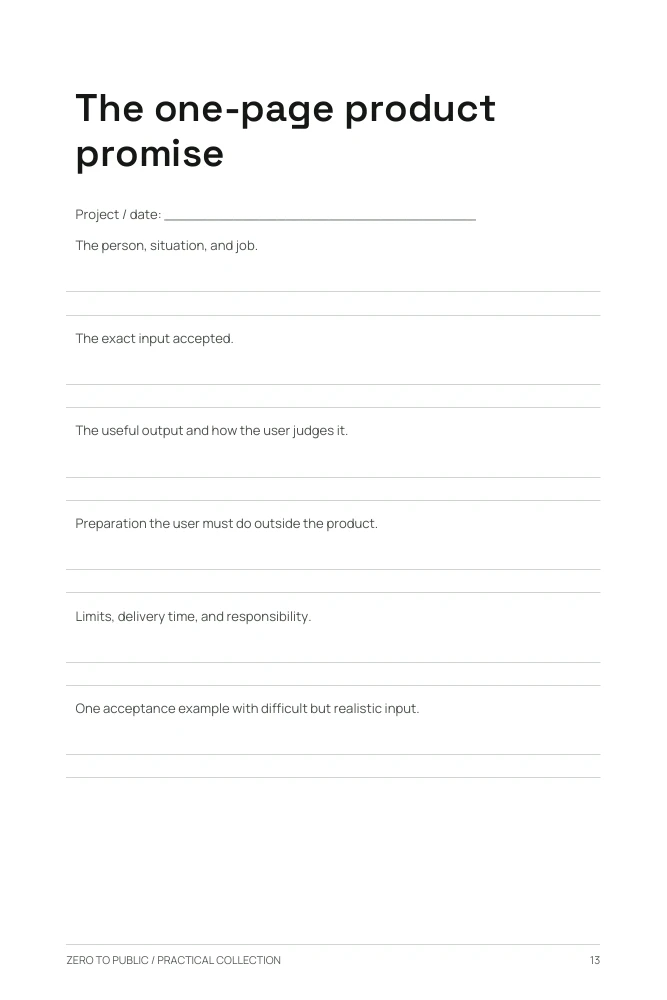
Use the strongest pattern to write a narrow promise:
For [specific customer] who struggles with [specific problem], [product or service] helps them achieve [specific outcome] without [major objection or unwanted tradeoff].
Then make the smallest believable version of that promise. It might be a clickable prototype, a short workflow, a spreadsheet, a service delivered through email, or a simple AI-assisted process. It does not need to be scalable. It needs to be understandable and useful.
For solo founders, manual delivery is often an advantage during validation. It lets you learn what the product must do before you encode assumptions into software. Your first version can have a human behind every button.
Show the offer to three or five relevant people. Watch where they hesitate. Ask what they think it does, what they would expect next, and what would stop them from trying it. Confusion is evidence. So is indifference.
Day 5: Ask for commitment
Validation becomes more credible when it asks for something real.
Depending on the product, commitment could mean paying a deposit, booking a session, connecting data, sharing a workflow, signing up for a pilot, introducing you to a decision-maker, or agreeing to use the product on a specific date.
Make the ask clear. “Would you use this?” is vague. “Would you pay €50 for us to process your next five customer calls and return a prioritized insight report by Friday?” gives someone a decision they can actually make.
A no is useful when you understand why. Is the problem weak? Is the timing wrong? Is the offer unclear? Is the buyer not the user? Is the price disconnected from the value? Record the reason instead of arguing with it.
Day 6: Deliver the concierge version
Take one or two early users through the complete experience manually. Do the work yourself if necessary. Observe setup, inputs, edge cases, delays, and the moment the customer receives value.
Ask what they expected, what they would remove, and what they would miss if the service disappeared. Pay attention to behavior after delivery. Do they use the result? Forward it? Ask for another one? Share it with a colleague? Behavior after the initial excitement often tells the truth.
This day also reveals operational reality. A product may sound valuable but require too much onboarding, trust, customization, or ongoing labor to be viable. That is not failure. It is an important constraint discovered cheaply.
Day 7: Make the decision
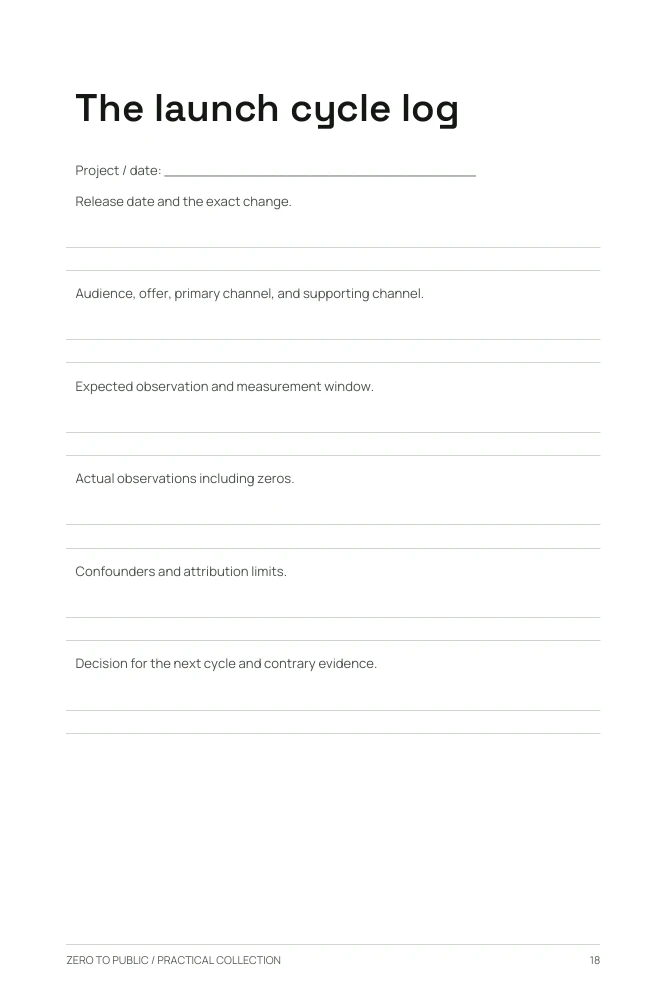
Review your evidence and write a one-page decision memo. Separate facts from interpretations.
Facts include the number of conversations completed, repeated problems, existing workarounds, commitments made, objections, and what happened during manual delivery. Interpretations include “the market is big,” “people will eventually pay,” or “we just need better marketing.” Keep those categories distinct.
Choose one path:
- Continue: The problem is repeated, urgent, and attached to real commitment. Define the next two-week build or delivery goal.
- Revise: The problem is real, but the customer, promise, workflow, or business model is wrong. Change one major assumption and run another focused test.
- Stop: The evidence is weak, the problem is not urgent, or the economics look poor. Keep what you learned and move on.
Validation sprint checklist
- [ ] I can name a specific customer group.
- [ ] I spoke with people who recently experienced the problem.
- [ ] I captured their language and current workarounds.
- [ ] I tested a small, understandable offer.
- [ ] I asked for a concrete commitment.
- [ ] I delivered or simulated the experience manually.
- [ ] I wrote down evidence separately from assumptions.
- [ ] I made a continue, revise, or stop decision.
Common mistakes
The most common mistake is building before recruiting reality. Another is interviewing only friends, fellow builders, or people who want to encourage you. Many founders also confuse attention with demand: views, likes, and waitlist signups can be useful, but they are weaker than a meaningful action.
Avoid changing five variables at once. If you alter the audience, problem, price, and channel simultaneously, you learn very little. Keep the sprint narrow enough to tell what caused the result.
Finally, do not turn validation into permission-seeking. The market is not a judge waiting to approve your idea. It is a source of constraints. Your job is to understand those constraints early enough to use them.
FAQ
Is seven days enough to validate a startup?
It is enough to test important assumptions and decide what to investigate next. It is not enough to prove long-term retention, market size, or a durable business.
Do I need a working product?
No. Start with conversations and a small offer. A manual or prototype version is often better because it exposes the real workflow before you invest in automation.
What if nobody agrees to pay?
Treat that as a signal, not a verdict. Check whether you reached the right people, described an urgent problem, made the value concrete, and asked for the right form of commitment.
Should I build an audience before validating?
An audience can help you reach people, but it does not replace evidence. Validation comes from relevant behavior and commitments, not from having a large following.
If you want a deeper, more honest guide to turning an idea into something real in public, read From Zero to Public at ZeroToPublic.com. Build in the open, but let reality edit the plan.
Build in public from zero.
Keep a record of the problem you chose, the offer you tested and the commitments people actually made. Use that evidence to decide what to build next.
From Zero to Public includes a 187-page field manual and access to the 58-chapter online library for $19 one-time.
View the current book offer — $19